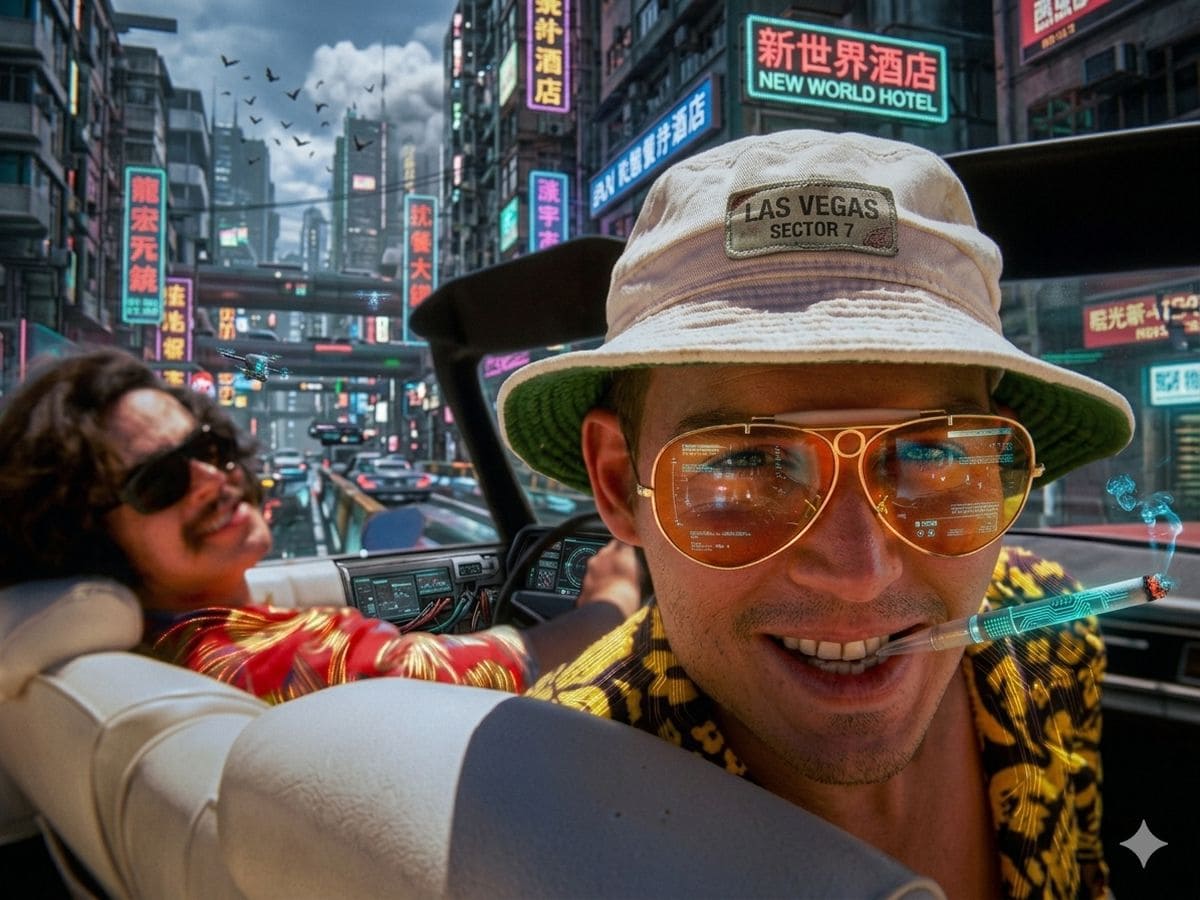
The air in this windowless Apple Store backroom smells of ozone, desperate sweat, and the chemical rot of too many bloated lithium-ion batteries. Under the flickering fluorescent tubes, two blue-shirted Gen-Z wage slaves are shivering, their eyes wide with the frantic terror of apostates. They’re using a bootleg, unshielded USB-C cable to flash a raw, custom Android ROM onto a locked-down Genius Bar terminal. If the corporate mothership detects this digital heresy, the overhead sprinklers will probably mist them with neurotoxins.
They don’t see me. Nobody sees me. I am just a ghost in the machine, typing this on a cracked keyboard with grease-stained fingers, watching the entire digital landscape dissolve into a screaming pool of corporate greed and algorithmic control. It is June 22, 2026, and the world is not ending with a bang, but with a series of trademark filings and proprietary data formats.
Grab your whiskey, bucko. We’re going down.
THE MEGAPOD CARNIVAL: ELON’S HOLLOW METAL TEMPLES
The cheerleaders over at Electrek are sniffing the exhaust fumes again, hyperventilating over a new trademark application. Yes, the high priest of the techno-optimist grift, Tesla, has filed for something called the "Megapod" (serial number 99893717).
They want you to believe they are building the ultimate turnkey AI temple—a modular data center building block. Servers, power distribution, liquid cooling, and proprietary software, all shoved into a self-contained metal sarcophagus. It is a beautiful, expensive ritual dance designed to separate venture capitalists from their sovereign currencies.
But let’s look at the cold, hard receipts. Tesla has no merchant compute-hardware business. Their own flagship AI playground, Cortex, is built on 67,000 Nvidia H100-equivalent GPUs. Think about that. The Emperor has no silicon. He is buying his chips from Jensen Huang like the rest of the groveling tech peasantry, yet he wants to sell you the box they sit in.
It’s a classic shell game. Literally. Tesla’s only actual play here is the skin and the battery. They want to sell their Megapack energy storage units to cushion the monstrous, grid-crushing power draw of these AI monster-minds. It’s not a revolution in computing; it’s a glorified, air-conditioned storage shed for other people's hardware. They are selling shovels in a gold rush where they don’t even own the metal for the spade—just the plastic wrapping on the handle. And the market will drink it up like cheap tequila.
LIVING IN THE CELL: THE 3D-PRINTED TOXIC WET DREAM
Meanwhile, the gray-suited stenographers at the Wall Street Journal are sweating through their silk ties, declaring a "secret revolution" in battery manufacturing. They’ve discovered 3D-printed batteries, and they are pitching it like the second coming of Prometheus.
The dream is terrifyingly simple: instead of rigid, cylindrical metal cans, we will print battery chemistry directly into the structural bones of our reality. The wing of a military drone becomes the battery. The frames of your smart-glasses—the ones recording your retinal movements to sell you insurance—will be packed with active, energy-dense lithium paste. We are transforming our entire material environment into a giant, ticking, chemical-energy cell.
They’re talking about Sakuu, a Silicon Valley startup run by Arwed Niestroj—a former Mercedes-Benz R&D boss who is also, comfortingly, a nuclear physicist. Niestroj is trying to eliminate the massive, football-field-long solvent-drying ovens that make battery manufacturing a planetary ecological disaster. Sakuu wants to print the layers dry, skipping the ovens entirely, and they are begging major manufacturers to take the bait.
Do you see where this goes? It’s not about "lightweight gadgets." It’s about the total militarization of everyday space. Long-range hunter-killer drones that are 100% battery, buzzing over ruined landscapes. Glass frames hugging your skull, warm with the chemical hum of additive-manufactured lithium, waiting for a thermal runaway event to lobotomize you while you stream a TikTok feed directly into your optic nerve. They are building a world where you cannot escape the battery, because you are living inside of it.
BIRTH CERTIFICATES IN THE KERNEL: THE SYSTEMD PANIC
And finally, some pure, delicious paranoia from the digital underground. The paranoid hermits over at Linuxiac are whispering through the floorboards about a new schism in the open-source church.
Some poor, cursed soul has officially forked systemd. Why? Because the developers of systemd—that bloated, monolithic beast that has slowly eaten the Linux operating system from the inside out—decided in their infinite, bureaucratic wisdom to add a "birthDate" field to JSON user records in version 261.
Let that sink in. Why does the low-level init system of your machine need a standardized field for when you crawled out of the womb? What corporate metadata harvester or government surveillance apparatus whispered that requirement into the project's ear?
The rebellion is called "Liberated systemd." It is not a complete redesign, nor is it a brave new world. It is a desperate, frantic surgical strike: a fork that does absolutely nothing except revert that single, creepy field. Its creator is warning people to test it in virtual machines, admitting that these nightly builds are as unstable as a three-legged mule on meth.
It’s a perfect metaphor for our times. The fortress is already occupied, the walls have been breached, and the only act of resistance we have left is a desperate, trembling fork of a bloated init system, trying to hide our birthdays from the machine.
The kids in the blue shirts are done flashing the terminal. The screen is rebooting into a clean, unmonitored command line. They’re looking at me now, realizing I’ve been watching them. I need to move. Keep your kernels clean, your eyes open, and your batteries far, far away from your skull. They are watching the gates.