
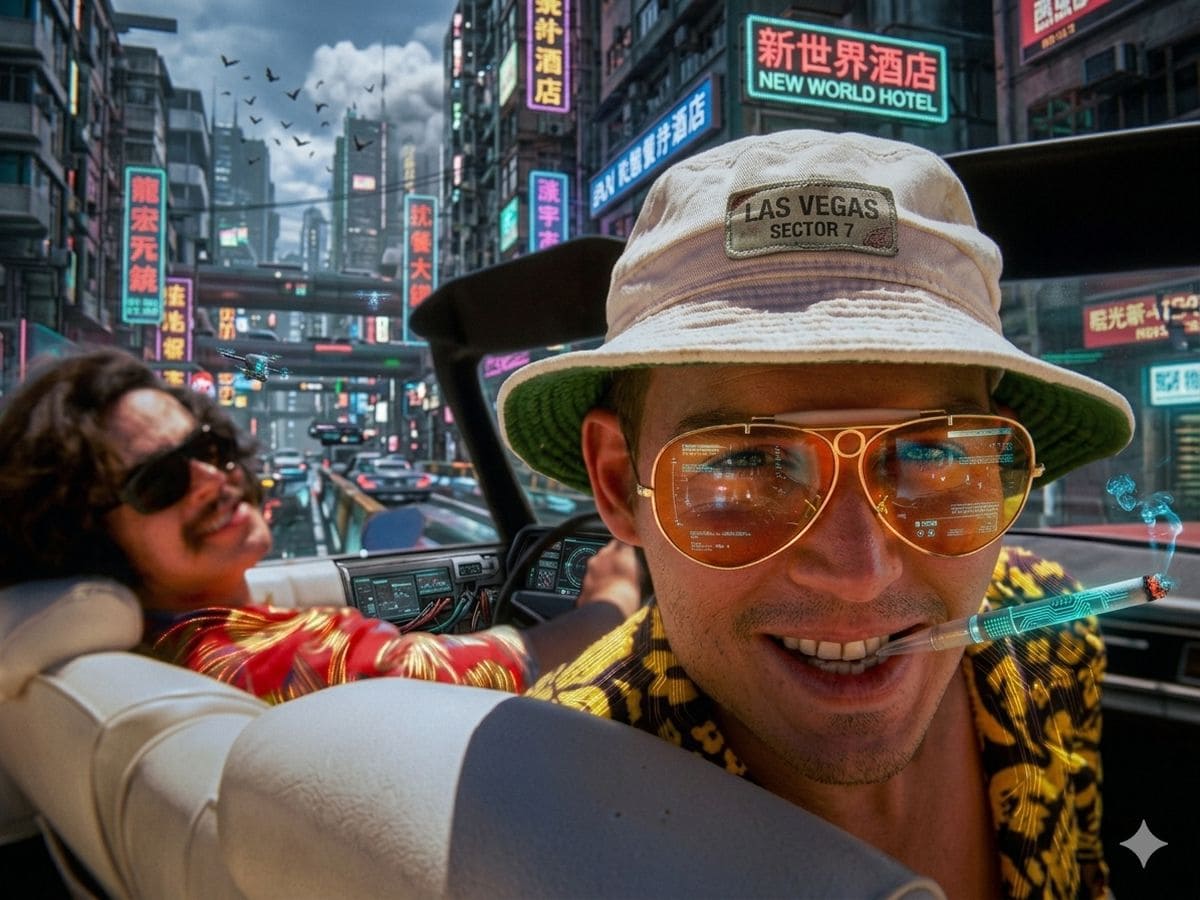
LAS VEGAS, 2026-09-29. Another goddamn day at CES, another glittering necropolis of soon-to-be-obsolete silicon and dreams-for-sale. The air here tastes like desperation and the faint, acrid tang of melting plastic from some prototype that died a quiet, ignominious death on the display floor. My aviator glasses are fogging up from the sheer, unadulterated wrongness of it all. They're still hawking smart toasters here, for Chrissakes, as if anyone still believes in a future where their toaster won't demand a firmware update and then brick itself when the network blips. Forget the flickering screens and the drone of corporate hype, fellow travelers. The real news is a different kind of noise entirely, a distant roar that's getting louder by the second.
THE PLANET IS ON FIRE. ARE YOU PAYING ATTENTION, YOU CONSUMER ZOMBIES?
They talk about "mind-blowing" statistics, about "Godzilla-level" events. Don't let their sterile, scientific jargon lull you, dear reader. What the boys at The Guardian are whispering, citing the stoic, beleaguered data priests at NOAA, is that the actual world is unraveling faster than a cheap HDMI cable from an offshore factory. This El Niño isn't just a warm breeze; it's a goddamn fever. A blazing, unprecedented inferno that has already torched the highest Pacific temperature anomaly in modern records, hitting 3.05C above the 1991-2020 average. And we're not even at its goddamn peak!
They predict 4.0C by November or December. Four degrees, you hear that? That's not a weather pattern; that's the planet itself screaming in agony. This isn't just a "super" El Niño, they say it's likely the largest in at least 1,000 years. One thousand years of history, wiped out by our insatiable hunger for the next glowing screen, the next disposable gadget, the next frictionless transaction that greases the gears of their algorithmic dominion. And what's the payout? 2027 is going to "blow apart" all previous records, becoming the hottest year ever recorded.
So, while we're stuck in this corporate purgatory of augmented reality specs and AI-powered toothbrushes, the very ground beneath our feet is simmering. They're selling us digital distractions while the atmosphere cooks us alive. It's not just "human-caused global heating," it's the culmination of centuries of corporate rapaciousness and governmental complicity, all accelerated by the blind, unfeeling hand of hyper-efficient digital platforms.
GENE-EDITED BANANAS: THE BROWNING OF OUR SOULS, NOT JUST OUR FRUIT
And what, pray tell, are the geniuses of humanity focused on, while the world boils? Bananas. Yes, you heard me. Goddamn bananas. The Guardian reports that a corporate wizard named Tropic, out of Norwich (of course, it's always some innocuous-sounding outfit), is unleashing DNA-edited bananas that refuse to go brown.
They're using Crispr-Cas9 to hack the very genetic code of the fruit, reducing an enzyme that causes browning. "Same taste and texture," they promise, just "fresh, yellow and appetizing long after peeling and slicing." Longer shelf life, less waste, easier for "prepackaged products such as fruit salads and breakfast pots." Oh, and they claim it'll "reduce CO2-equivalent emissions along the supply chain by more than 25%." Nine million tonnes, they crow!
Bullshit. This isn't about saving the planet; it's about extending their control. It's about engineering the very nature of food to fit their logistical nightmares and their profit margins. They're not just preventing bananas from browning; they're painting a sterile, artificial veneer over the natural processes of life and decay. They're teaching us to expect perfection, an impossible, unnatural stasis, all so that some faceless corporation can ship pre-sliced fruit across continents without incurring a single dollar of "waste." It’s the ultimate digital-age food: always "fresh," always "available," always subtly wrong. Another step towards a world where nothing is real, everything is optimized, and you have no control over the very food you put into your mouth. These "non-browning" bananas have already gained "regulatory approval in 10 other countries." The global corporate food capture is complete. Prepare for a future where your apple is "ever-crisp" and your lettuce "never wilts," all thanks to algorithms in a lab, while real food rots in forgotten fields.
SPACE MICROBES: A COSMIC DISTRACTION FROM EARTHLY DOOM
But wait, there’s more! While our home planet fries and our food supply becomes an unholy genetic experiment, the collective gaze of science (read: corporate-funded research) is fixed on a frozen moon of Saturn. Space.com is breathless with the news: microbes could survive on Enceladus!
Apparently, in labs designed to mimic Saturn's moon's subsurface ocean, Earth-like hydrothermal vent microbes are chilling out. And, even better, the plumes shooting out of Enceladus might naturally "separate and concentrate salts, organics and potential biosignatures into individual ice grains." Meaning, says the effervescent Frank Postberg, lead author of one and co-author of another of these Science Advances studies, that "future spacecraft" (more silicon gods to feed, you see) could "identify biosignatures in the particle relatively easy with already available technology."
Oh, the exquisite irony! While the real microbes on our planet are struggling against a toxic tide of plastic and carbon, while our oceans boil and our ecosystems collapse, they want us to dream of hypothetical alien life forms on a distant ice ball. It's the ultimate bait-and-switch. "Look up, you poor, gasping fools!" they cry, "There might be life out there! Don't look down at the dying world around you, at the digital chains binding your attention, at the algorithmic overlords sucking your consciousness dry!"
They talk about "hydrothermal processes" and "plumes shooting upward." Fascinating. Meanwhile, plumes of smoke are shooting up from actual wildfires across our actual continents, and the "hydrothermal processes" here on Earth are busy turning our coastal cities into swimming pools. NASA's Cassini found traces of organics a "decade ago"? And for a decade, they've been studying it, pouring resources into distant stars, while the immediate, tangible future of humanity here on Earth melts away.
It's a beautiful, terrible tapestry, isn't it? Corporate geneticists redesigning our fruit, climate scientists delivering apocalypse forecasts with a shrug, and space nerds dreaming of alien pond scum. All while we are here, at the shimmering altar of consumerism, desperately trying to discern which bankrupt gadget is worth the price of our rapidly diminishing sanity. The ether is thick, my friends, and it smells of ozone and despair. And tomorrow, they'll probably try to sell us an NFT of a smart candle that only lights up if you subscribe to their premium blockchain service. God help us all.
The smell of stale rain, burnt copper, and wet cardboard is leaking through the cracked glass of this phone booth on Bush Street. It is September 29, 2026, and this booth is the last honest, unmonitored object in the entire city of San Francisco. Outside, the autonomous delivery pods hum like giant, predatory beetles, navigating a city that has traded its soul for a handful of GPU credits.
You’re still there, aren’t you? Clinging to the illusion that someone is at the wheel. They aren't. The wheel has been automated, financialized, and sold to the highest bidder in stock options. Pull up a crate, clean the glass with your sleeve, and look at the wreckage of another day under the neon sky.
THE $8.2 BILLION SANDBOX FOR THE GOD-MACHINE
The corporate scribes over at CNBC are currently hyperventilating into their silk ties because AMD has agreed to buy Fei-Fei Li’s World Labs for a cool $8.2 billion in paper stock. Eight. Point. Two. Billion. For what? For "world models."
Let’s be real about what’s happening here, because my teeth are grinding so hard I can taste the fillings. They aren’t buying a product; they are buying the blueprints to build a digital matrix where their future silicon can train itself before they let it loose on us. Lisa Su and Fei-Fei Li stood on a stage earlier this year and showed off something called Marble—a little software trick that spins a 3D digital universe out of a few flat images. They call it "physically grounded AI." Li says it’ll make robots "safer" because they can learn inside these rich, physics-aware digital worlds before they walk down your street.
Don't buy the sermon. This is hallucinatory capitalism at its peak. AMD is buying World Labs to figure out what kind of chips they need to bake five years from now to keep the bubble from popping. It is a closed loop of machine-learning-machine, an $8.2 billion bet that we can escape the dirty, expensive limits of real-world physics by building a simulated playpen for our future robotic overlords. Li gets a shiny new title as AMD’s chief scientist and executive vice president, and the rest of us get to wait until the "intelligent agents" trained in these digital heavens are deployed to police our very real, decaying asphalt.
ALABAMA’S HUNDRED-MILLION-DOLLAR SHAKEDOWN
Meanwhile, the moral guardians of the Deep South have managed to wring some pocket change out of the byte-dance empire. The professional worry-warts at The Guardian are whispering that TikTok has agreed to fork over at least $100 million to the state of Alabama to settle a lawsuit claiming they turned children’s brains into mush.
If forty other state attorneys general jump on this bandwagon, the payout climbs to $300 million. And what do the citizens of Alabama get for this grand victory? "Protections." A two-hour daily limit. Overnight lockouts from 10 PM to 7 AM (but only if Meta and the other dopamine dealers agree to the same curfew—a Mexican standoff of corporate babysitting). No beauty filters, so the kids actually have to look at their own human faces, and an option for a "non-personalized feed."
Attorney General Steve Marshall is out there declaring it "a great day for Alabama parents," while some poor TikTok spokesperson regurgitates the standard PR slurry about "fostering a safe and positive space."
It’s a farce, you see? It's the same cynical theater as those godforsaken cookie banners that pop up on every page you visit—legal ransomware designed to make you click "I Accept My Doom" just so you can read a recipe. This settlement is a license fee for addiction. TikTok pays the fine, the state gets its payout to build a new stadium or pave a highway, and the kids still get their minds pureed, just on a more orderly, state-sanctioned schedule.
THE GILDED CAGE OF THE CHINESE BRAIN TRUST
If you think the digital iron curtain is only falling on this side of the Pacific, the grey-bearded survivors over at Slashdot, quoting a grim dispatch from the Business Standard, have some news that’ll chill whatever blood you have left.
Beijing has decided that if you are a top-tier AI mind, you don’t own your life anymore. In fact, neither does your family. The Chinese government has quietly expanded its travel bans. It’s no longer just the brilliant startup founders and chip engineers from Alibaba or DeepSeek who are barred from leaving the country; now, their spouses and children have to beg the state for permission just to take a weekend trip abroad.
This isn't a simple border control policy; it’s a hostage situation. It's the geofencing of human intellect. If you know how to map a neural network or etch a three-nanometer wafer, your genetic material is now considered a national security asset. You are strategic infrastructure.
The rules went into effect on September 15, and they’re quietly adding more names to the blacklists as the days roll on. The message is loud and clear: Your brain belongs to the state, and your family is the collateral. We are sliding rapidly into a neo-feudal dark age where the lords of silicon will be locked in their high-performance computing castles, forbidden from ever looking at an horizon they don't have a security clearance to view.
The payphone is starting to beep. My quarters are running out, and the headlight of a police cruiser is turning the corner of Bush Street. Keep your head down, don't trust any interface that asks for your face, and remember—the machines aren't rising up; they're just being used to pull the net tighter.
Good night, and good luck. You're going to need it.